
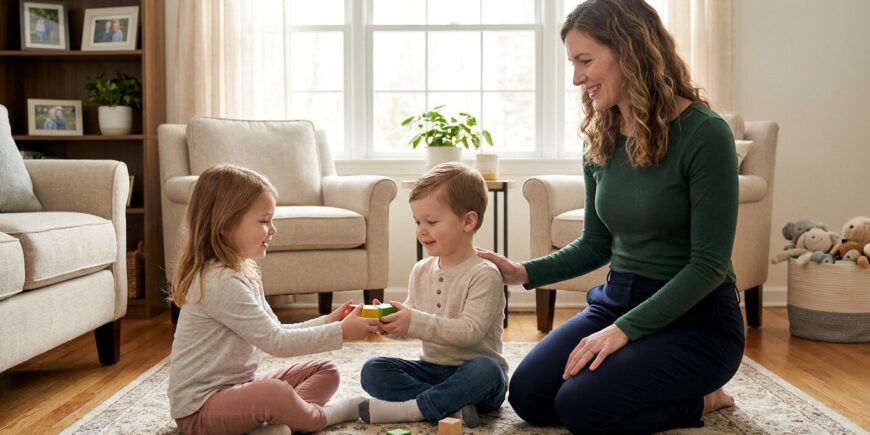
If you are looking for guidance on ABA therapy for siblings, you are probably trying to support more than one child at the same time. One child may be receiving ABA therapy, while another is adjusting to changed routines, divided attention, and emotions they may not know how to name yet. Parents often wonder whether ABA can help siblings feel closer without making home life feel overly clinical.
The short answer is yes, ABA can support sibling relationships when it is used to improve communication, predictability, and shared success in daily routines. It cannot and should not make a sibling responsible for therapy. The goal is not to turn brothers or sisters into helpers. The goal is to help family life feel more workable, more respectful, and more connected.
How sibling relationships can change when one child is in ABA therapy
When one child begins ABA, family routines often shift quickly. There may be new schedules, new expectations, different transition plans, and more adult attention directed toward one child’s communication, behavior, or daily living goals. Even when these changes are positive, siblings notice them.
That pressure can show up in everyday moments: after school when everyone is tired, during play when one child wants more structure than the other, during outings that need extra planning, or in therapy-heavy parts of the week when family time feels less spontaneous. Some siblings become clingy. Some seem irritated or argumentative. Others become unusually helpful, which can look mature on the surface but sometimes signals stress underneath.
Age matters here. Younger siblings may show confusion through behavior rather than words. School-age siblings are more likely to focus on fairness and compare what each child gets. Teen siblings may look calm while quietly pulling back, feeling embarrassed, or taking on too much responsibility. If conflict has already become a bigger household pattern, it can help to read more practical household guidance in Managing Sibling Rivalry When One Child Is on the Spectrum.
Why siblings may feel left out, confused, or over-responsible
Many siblings are trying to make sense of changes they did not choose. They may notice that their brother or sister gets more one-on-one attention, different expectations, or extra support during difficult moments. Without a clear explanation, that can feel unfair even when the reasons make sense to adults.
Some siblings respond by asking more questions. Others respond by staying quiet. A younger child may act out because they want the same level of attention. A school-age child may start saying things like, “Why does he get that and I don’t?” A teen may stop asking for help because they do not want to add pressure to the household. These reactions do not mean a sibling is selfish. They usually mean they are trying to understand their place in a family rhythm that has changed.
It is also important to separate empathy from hidden caregiving. A sibling can be kind, patient, and included without becoming a behavior monitor, prompt giver, or junior therapist. Healthy involvement supports connection. Parentification shifts adult responsibility onto a child. That line matters, especially for older siblings who may look capable long before a role is actually appropriate.
What ABA can realistically support in sibling relationships
ABA can support sibling relationships by helping families build better communication, more predictable routines, clearer transitions, and more successful shared moments. When therapy goals are carried into real life thoughtfully, siblings may have more chances to play together, understand each other’s needs, and recover more smoothly after difficult interactions.
What ABA should not do is force closeness, pressure a sibling to participate, or promise a fast relationship change. Therapy can support the conditions that make sibling connection more likely, but it cannot erase stress overnight. Research and clinical practice suggest that children do better when support is consistent, realistic, and connected to daily life rather than isolated to session-only moments.
A family-centered approach is especially important here. Parent coaching can help adults decide what sibling goals are realistic, how to explain therapy in plain language, and how to support carryover without turning family life into constant practice. That is one reason resources on The Role of Parent Training in ABA can be so helpful. When support happens inside natural routines, such as getting ready for school, playing a short game, or moving through dinner and bedtime, in-home ABA therapy may also create useful opportunities for generalization.
Parents and BCBAs usually stay better aligned when they agree on a few simple points:
- what a successful sibling interaction would look like for both children
- which moments are appropriate for sibling involvement and which should stay adult-led
- how to keep participation optional and easy to exit
- how to respond after conflict so repair is part of the plan
- how to notice whether both children are getting attention, not only whether therapy targets are progressing
The Sibling Rhythm & Role Map
Spot the pressure points
Start by asking where strain is actually happening. It may be during transitions into therapy, after-school decompression, shared tablet time, a bedtime routine, or family outings that now require more structure. Naming the pressure point is more useful than labeling one child as the problem.
For example, maybe a younger sibling gets upset every time the therapist arrives because it changes the afternoon routine. Maybe an older sibling becomes irritated at dinner because so much of the conversation centers on one child’s day. These details help parents and clinicians respond to the real pattern instead of making broad assumptions.
Clarify each child’s role
A sibling’s role should be simple, voluntary, and age-appropriate. Joining a turn-taking game for five minutes, helping choose between two play activities, or practicing a predictable greeting can be appropriate. Managing behaviors, correcting responses, or keeping a brother or sister on task is not.
When families clarify roles early, helping stays healthy. Siblings can be included without carrying the weight of therapy. Parents and clinicians remain responsible for structure, prompting, coaching, and behavior support.
Choose low-pressure connection moments
The best shared moments are usually short and realistic. Think of a brief board game with adult support, a simple back-and-forth play routine, a visual choice between two activities, or a transition where both children know what comes next. The point is connection and confidence, not convenience for adults.
Younger children usually do best with concrete, brief roles. Teens usually do best when they have real choice, privacy, and a clear option to step out. If either child is already dysregulated, it is often better to pause and save sibling involvement for a calmer moment.
Repair after hard moments
Even strong sibling relationships have jealousy, exclusion, and frustration. What matters is what happens next. Repair may look like naming what happened without blame, validating both children’s feelings, and helping them reconnect in a smaller and more manageable way later.
A parent might say, “That felt hard for both of you. You wanted more time with me, and your brother was already overwhelmed. We are going to reset and try again later.” This keeps the focus on understanding and repair instead of shame.
Rebalance attention over time
Family progress is not only about whether therapy goals are being met. It is also about whether both children feel seen. Rebalancing attention may mean a short one-on-one errand with the sibling who has been waiting patiently, a predictable bedtime check-in, or a weekly routine that belongs to the other child too.
Perfection is not the goal. A sustainable rhythm is. When parents regularly ask, “Does each child feel supported in this family?” sibling trust has more room to grow.
Age-appropriate ways siblings can participate without pressure
Younger siblings
Younger children need simple explanations and very short roles. You might say, “Your sister is practicing talking and playing in new ways, and the therapist is here to help.” Participation can be as small as taking one turn in a game, joining a song, or helping choose a toy. A younger sibling should never be expected to stay regulated for a long session or help manage another child’s behavior.
School-age siblings
School-age children often need direct answers about fairness. They may benefit from being told what is and is not their job, having space to ask honest questions, and being invited into short routines only when it makes sense. Praise kindness, flexibility, and patience, but be careful not to reward over-functioning. A cooperative child still needs room to be a child.
Teen siblings
Teen siblings usually need respect for privacy, schedule pressure, and mixed emotions. They may be willing to join a brief family routine, help plan a calmer transition, or participate in a shared activity, but that involvement should be by choice. Maturity should not be confused with availability for caregiving. A teen should be able to opt in, opt out, and say when something feels too personal or too demanding.
What parents should avoid when trying to include siblings
Avoid involving a sibling mainly because it makes the moment easier for adults. Avoid asking a sibling to prompt, correct, monitor, or run practice in ways that shift therapy work onto them. Avoid forcing shared routines when either child is already overwhelmed.
It is also important not to assume sibling involvement is always helpful. Sometimes the best choice is an adult-led moment, a shorter routine, or no shared practice at all that day. And when a difficult interaction happens, do not skip repair. Tension that gets ignored tends to show up again.
Decision Tool: Should My Child’s Sibling Be Part of This ABA Moment?
Use this quick check before inviting a sibling into a routine, play activity, or therapy-adjacent moment:
- Is the goal connection or shared success, rather than convenience for the adults?
- Is the autistic child regulated enough for shared participation right now?
- Does the sibling actually want to join?
- Is the sibling’s role simple, optional, and age-appropriate?
- Would this plan shift adult therapeutic responsibility onto the sibling?
- Is there a clear stop point if either child becomes frustrated?
- Do the adults know what success looks like for both children, not just one?
- Is there a plan for praise, repair, or one-on-one reconnection afterward?
If the answer to several of these is no, it is usually better to keep the moment adult-led or wait for a calmer opportunity.
FAQ: Common questions about siblings and ABA therapy
How can siblings be involved in ABA therapy?
Siblings can be involved in small, optional, age-appropriate ways, such as joining a short game, practicing turn-taking, or taking part in a familiar routine. They should not be expected to manage behaviors, give prompts, or carry therapy responsibilities.
What are the benefits of sibling participation in ABA therapy?
When boundaries are healthy, sibling participation can support communication, empathy, predictability, and small moments of shared success. The benefit comes from connection, not from expecting one child to help run the process.
How does ABA therapy affect sibling relationships?
ABA can improve sibling relationships by making routines smoother, communication clearer, and conflict repair more intentional. At the same time, strain can increase if fairness, attention, and boundaries are ignored. The effect depends a lot on how support is carried into family life.
How do you explain ABA therapy to a sibling in an age-appropriate way?
Use plain language. A younger child may only need, “Your brother is learning new skills, and these adults are helping him.” An older child may want a fuller explanation and more room for questions. At every age, it helps to say clearly that support for one child does not mean less love or care for the other.
What are healthy boundaries for sibling involvement in therapy?
Healthy boundaries mean participation is voluntary, brief, and easy to stop. Adults remain responsible for teaching, prompting, structure, and behavior support. Siblings can be included, but they should never be expected to function as caregivers or therapists.
At Aim Higher ABA, sibling support is most meaningful when it strengthens everyday family life. That means helping skills carry into real routines, protecting each child’s dignity, and building connection without placing too much on the sibling who is simply trying to grow up alongside it all.

 Previous Post
Leave Your Comment