
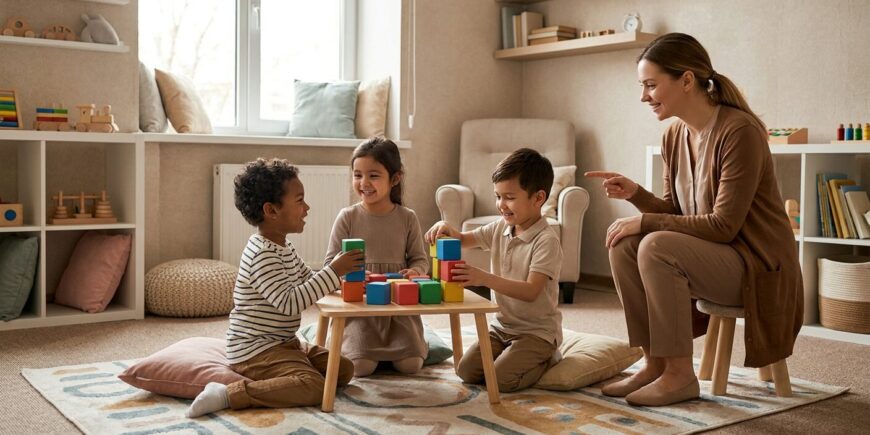
If you are looking into social skills groups for autism, you are probably weighing two questions at the same time. Could this kind of support help your child feel more confident with peers? And is a group setting the right fit right now?
Those are fair questions. For many families, the appeal of group therapy is easy to understand. It offers a chance to practice important social skills with other children in a structured setting instead of only talking about those skills one-on-one. At the same time, parents often want more than a broad list of benefits. They want to know what group therapy actually looks like, which children tend to benefit most, and how to tell whether a specific program is a good match.
This guide is meant to help with that decision. It explains what ABA social skills groups are designed to support, why they can be helpful, what a typical session may involve, and how to evaluate whether a group is likely to meet your child where they are.
What ABA social skills groups are designed to help with
ABA social skills groups are meant to help children practice interaction skills in the presence of peers, not just in one-to-one teaching. Depending on the child’s age and goals, that might include shared attention, turn-taking, flexible play, conversation, coping with losing, reading basic social cues, or working through small peer problems.
The goal should not be to make a child sound scripted or push them to hide who they are. A good group focuses on functional, meaningful skills that support daily life. That might mean helping a preschooler join a short play routine, helping a school-age child handle the back-and-forth of friendship more comfortably, or helping an older child manage group expectations and communicate more clearly with peers.
For younger children, social goals often center on joining routines, imitating peers, playing near others, and tolerating short shared activities. For school-age children, the focus may shift toward entering play, taking turns in conversation, recovering from small frustrations, and building early friendship skills. Older children and teens may need support with perspective-taking, collaborative problem-solving, and maintaining relationships over time.
If you want more background on how ABA can support social development more broadly, this guide on using ABA to improve social skills and this overview of social skills training in ABA offer a helpful starting point. In many cases, group work is one part of a larger support plan, not the only service a child needs.
Why ABA social skills groups can be helpful
One of the biggest strengths of group therapy is that it gives children a chance to practice social skills in real time with other people. That matters because many social skills are hard to build in isolation. A child may understand a concept in a one-to-one session, but using it with peers often feels very different.
In a strong group setting, children are not only hearing about a skill. They are seeing it modeled, trying it themselves, getting support when they get stuck, and learning how to repair interactions when things do not go smoothly. That is often where growth happens.
Depending on the child, benefits may include:
- more comfort entering shared activities
- stronger peer awareness
- better conversational back-and-forth
- more flexibility during games or group routines
- improved tolerance for waiting, turn-taking, and small disappointments
- more confidence using skills outside therapy
Progress does not always look dramatic. Sometimes it looks like joining a game with less prompting. Sometimes it is waiting through one more turn, noticing how a peer is feeling, or recovering more calmly when plans change. Those smaller changes matter because they often build toward more meaningful participation at home, at school, and in the community.
For preschoolers, gains may show up as smoother transitions into group play and more tolerance for simple routines with other children. For school-age children, progress may look like better reciprocity, stronger play skills, and more successful participation in classrooms, clubs, or playdates. For older children and teens, the benefit may be more nuanced communication, better self-advocacy, and more confidence handling the social uncertainty that comes with peer relationships.
If you want a broader look at how these skills can carry into everyday life, this article on helping children connect with others through ABA and this piece on carrying social skills from the classroom to the playground are useful next reads. It is also important to keep expectations realistic. Group therapy can be very helpful, but it is not a guarantee of quick progress or easy friendships. Fit, readiness, and program quality all matter.
Signs a child may benefit from group therapy, and when one-to-one support may come first
A child does not need to be highly social or fully independent to benefit from a group. In many cases, a good starting point is simply that they show some awareness of peers, can participate near others for short periods, and can recover from mild frustration with support.
Some signs a group may be a good fit right now include:
- emerging interest in peers, even if interaction is still limited
- the ability to stay near others during short structured activities
- some tolerance for waiting, transitions, or shared materials
- communication skills that can be practiced in a group setting
- the ability to re-engage after small setbacks with support
That can look different by age. For a preschooler, readiness may mean joint attention, imitation, and tolerance for short shared routines. For a school-age child, it may mean responding to peers, staying engaged through a game, or managing small frustrations without shutting down entirely. For older children and teens, readiness may include willingness to participate, some basic social insight, and the ability to handle a little ambiguity in peer interaction.
At the same time, some children may benefit from more individualized support first. If a child is frequently overwhelmed in shared settings, has significant safety concerns, struggles heavily with transitions, or cannot yet participate around peers in a workable way, one-to-one ABA or another more individualized support model may be the better starting point.
That does not mean group therapy is off the table. It often just means the child may benefit from building a stronger regulation and communication baseline before group learning becomes productive. For some families, the right answer is not group instead of individual support. It is a blended approach, or a plan that starts one-to-one and adds group therapy later.
If you are trying to think through that bigger decision, this guide on how to decide if ABA therapy is right for your child can help frame the conversation.
What a typical ABA social skills group session may look like
Every provider runs groups a little differently, but many sessions follow a similar rhythm.
A session often starts with arrival and transition support. Children settle into the space, get oriented, and review the expectations for the group. That first part matters because the ability to shift into the session can shape how the rest of the time goes.
From there, the facilitator may introduce a specific target for the day, such as taking turns in conversation, joining play, asking for help, handling a game loss, or working through a simple social problem. The skill is usually modeled first, then practiced in a structured way.
Practice may happen through role-play, games, collaborative activities, or play-based routines. Facilitators often give prompts when needed, reinforce successful attempts, and help children recover from small mistakes without turning the session into a high-pressure performance. If waiting becomes difficult or frustration starts to build, the goal is usually to support regulation and help the child return to participation when possible.
At the end, families may get a brief handoff about what was practiced, what kind of support helped, and what a realistic carryover opportunity might look like at home or in the community. That piece is important because progress tends to be more meaningful when the skill starts showing up outside the therapy setting too.
Group size, peer match, pacing, and supervision matter a lot. A good group is not just several children in one room. It is a structured environment with clear goals, appropriate oversight, and a thoughtful match between age, skills, and support needs.
If you want examples of how social learning can show up in more natural activities, these posts on group games that build friendship skills and group activities that support communication and social engagement offer helpful context.
Use the GROUP Match Lens to evaluate fit
When families compare programs, it helps to look beyond general promises about “building social skills.” A clearer way to think about fit is the GROUP Match Lens.
G: Goal clarity
Start with the real goal. Is your child working on joining play, taking turns, having more balanced conversations, coping with losing, becoming more flexible, or maintaining friendships over time? A program can sound strong on paper but still be the wrong fit if it is not targeting the skill that matters most right now.
R: Regulation baseline
Think about whether your child can tolerate shared space, transitions, waiting, and mild frustration often enough for group learning to be useful. Good programs support regulation, but even a strong group has limits if participation falls apart constantly.
O: Openness to peers
Look at where your child is starting. Do they notice peers, respond to simple approaches, imitate others, or show any willingness to participate alongside them? Openness does not need to be fully developed. It just needs to be present enough for the group to build on.
U: Useful group structure
Ask how the group is put together. What is the age range? How are peers matched? How large is the group? What qualifications do the facilitators have? How fast does the group move? Does the provider build in parent communication and carryover? Structure matters more than broad marketing language.
P: Progress plan
Find out how progress is measured. Are providers only describing what happens during sessions, or are they also helping families notice changes at home, at school, or in the community? Meaningful progress is about real-world success, not just whether a child did well during one hour of therapy.
ABA Social Skills Group Comparison Scorecard
If you are comparing a few local options, it can help to make a simple scorecard. You do not need anything fancy. Just look at each program side by side and write down:
- your child’s main social goals
- current readiness markers
- age and peer match
- facilitator qualifications and BCBA oversight
- session format and group size
- whether modeling, role-play, and guided feedback are built in
- how the team responds when a child becomes overwhelmed or dysregulated
- what parent communication and carryover support look like
- how progress is tracked over time
- practical details like waitlists, scheduling, and insurance coverage
This kind of comparison can make a big decision feel more manageable. It keeps families focused on fit, not just on whether a provider offers a social skills group at all.
How group work can fit with individual ABA and home support
For many children, social skills groups work best as part of a broader plan. Group therapy can create valuable opportunities to practice with peers, while individual ABA can help build the personalized foundation that makes group participation more successful.
That foundation may include communication, emotional regulation, flexibility, transitions, or other skills that are easier to teach in a more individualized setting first. Once those pieces are stronger, group practice often becomes more productive and less overwhelming.
Home support matters too, but that does not mean parents need to recreate therapy in the living room. In most cases, the most helpful carryover is simple and realistic. It may look like noticing when a target skill comes up naturally during play, mealtime, a sibling interaction, or a community outing and giving the child space and support to use it.
For families who want to learn more about that kind of carryover, these resources on why parent ABA training matters, keeping ABA strategies consistent between home and school, and supporting ABA goals at home in a realistic way can help.
The bigger point is that social growth usually happens over time. It is often uneven. Some settings will feel easier than others. A good program makes room for that reality and stays focused on meaningful progress, not perfection.
Frequently asked questions
What are the benefits of social skills groups for children with autism?
Social skills groups can give children a structured place to practice interaction with peers, build confidence, improve communication, and use skills in more natural situations. The benefit often comes from guided practice, modeling, feedback, and repetition in a shared setting.
What happens in an autism social skills group?
Many groups include a transition into the session, direct teaching or modeling of a target skill, guided practice through activities or play, support during moments of frustration or waiting, and a short parent handoff at the end. The exact format depends on the provider, age range, and goals of the group.
How do I know if my child is ready for a social skills group?
A child may be ready if they show some awareness of peers, can participate near other children for short periods, and can return to the activity after small frustrations with support. If shared settings feel consistently overwhelming, more individualized support may be a better first step.
How does ABA support social skills group therapy?
ABA can help structure group learning through modeling, prompting, reinforcement, guided feedback, and careful tracking of progress. In a strong program, those strategies are used to support meaningful participation and real-world carryover, not to force scripted behavior.
What should parents ask before enrolling in a group?
Ask about group size, peer matching, facilitator qualifications, BCBA oversight, how skills are taught, how dysregulation is handled, how progress is measured, how families are updated, and what the practical expectations are for scheduling, insurance, and carryover.
Final thoughts
ABA social skills groups can be a valuable way to help children build confidence, practice interaction, and use social skills with peers in a more realistic setting. The key is not simply finding any group. It is finding one that matches your child’s goals, readiness, and support needs.
When a group is thoughtfully structured and paired with the right level of individualized support, it can become a meaningful part of a child’s progress in daily routines, relationships, and real-world participation.

 Previous Post
Leave Your Comment