
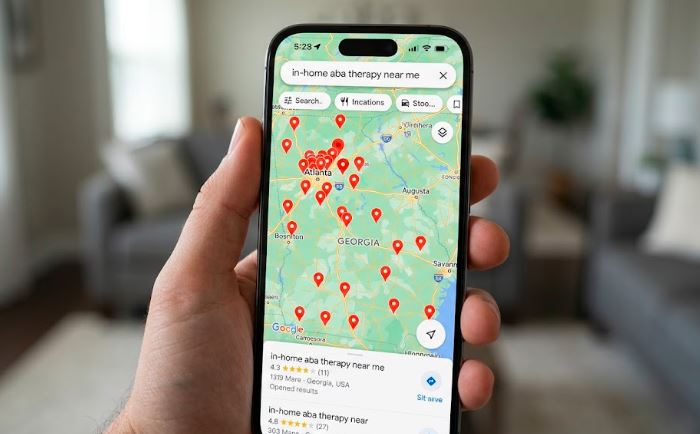
If you are a Georgia parent searching for in-home ABA therapy services near you, a long list of results can feel reassuring at first. But a map pin or provider page only identifies a possible option. It does not prove that the provider serves your exact address, offers sessions in your home, accepts your specific plan, has an opening, or is a good fit for your child and family.
This guide offers a simple way to check those details before you share records or schedule an assessment. The same questions can help whether you are considering Aim Higher ABA or another provider.
Quick Summary: Four Checks Before You Call
- Address: Confirm your city, county, ZIP code, requested setting, active travel radius, and when the service-area information was last verified.
- Care fit: Ask about the setting, age range, goals, caregiver expectations, and how the program would fit your child’s daily routines.
- Coverage: Confirm the specific Medicaid or commercial plan, network status, authorization requirements, deductibles, copays, and who handles the paperwork.
- Availability: Ask whether a BCBA and direct-care team are available, what the intake and assessment steps include, and what timeline can realistically be supported.
These checks cannot guarantee an opening or a particular outcome. They help turn a broad “near me” search into a more useful conversation.
Why Georgia “Near Me” Results Can Mislead
A map pin, “statewide” statement, city list, directory profile, or sponsored result may show that a provider has a connection to a region. It does not necessarily mean a clinician can travel to your home now. A location page may describe a service area, while a directory may contain information that was added or verified at a different time.
Keep these four questions separate:
- Is the provider listed in the area?
- Does the provider accept your specific plan?
- Is the provider currently accepting referrals?
- Can the provider serve your address, setting, and schedule?
A provider can be listed in a Georgia county but be out of network for your plan, have no team available for your ZIP code, or offer only a different setting. Access can also look different in Metro Atlanta, Augusta, Savannah and coastal Georgia, Macon and Central Georgia, Columbus, and rural counties. A statewide claim is not proof of equal capacity everywhere.
“In-home” describes where services may take place. It does not automatically tell you about quality, availability, or fit. Home, clinic, school, community, and telehealth parent-training options may serve different needs. For broader selection guidance, see how to choose the right ABA therapy provider without making distance the only deciding factor.
The AIM Higher 5A Georgia Fit Compass
The AIM Higher 5A Georgia Fit Compass is a local verification tool. It helps move from a search result to a service match that works for the child and family. It complements, rather than replaces or renames, Aim Higher’s existing 7 Pillars positioning.
Address
Start with the exact city, county, ZIP code, and requested setting. Ask for the provider’s active travel radius, not just the places listed on its website. Confirm that the answer applies to your home or school location, preferred days, and current travel conditions. It is also reasonable to ask when the service-area information was last checked.
Access
Ask whether the provider works with your specific Georgia Medicaid plan or commercial plan. “We accept insurance” is not the same as being in network with your plan. Confirm the diagnosis documentation, medical-necessity review, prior authorization, benefit limits, deductibles, and copays that may apply. Ask who verifies benefits and who manages authorization or claims.
If you want more background before making calls, review this guidance on ABA therapy insurance and benefits. The goal is not to predict your coverage, but to know which questions to ask your plan and the provider.
Alignment
Consider your child’s age, communication, social, self-care, and daily-living priorities. Also ask whether goals can be supported at home, school, or in the community, and whether the approach fits your family’s routines and priorities.
Service pages may list different age ranges by program or location. Do not assume a provider serves only young children, and do not assume a general page covers every age group. Ask directly about your child’s age, goals, and setting. A suitable program should be individualized, measurable, respectful of dignity and assent, and realistic about what it can support.
Availability
Ask whether a BCBA and direct-care team are currently available for your area and requested schedule. Have the provider explain the path from inquiry to intake, assessment, authorization, staffing, and scheduling. Ask how cancellations, absences, and staff changes are handled.
A clear explanation of milestones is more useful than a fixed start-date promise. Availability can change, especially when services are delivered by a mobile team across multiple communities.
Assent and Partnership
Pay attention to how the provider includes caregivers, explains progress, and responds when a child does not assent or a goal needs to change. Ask how data is shared, how concerns are raised, and whether the team coordinates with school staff when appropriate.
A respectful partnership leaves room to reassess fit. Families should feel able to ask questions and understand why goals, schedules, or supports may change.
Local ABA Provider Verification Worksheet
Use one row per provider and record the date of each answer. This turns your search into a comparison of confirmed details rather than a list of phone numbers.
| Check | Provider 1 | Provider 2 | Provider 3 |
| Listing source and date checked | |||
| City, county, ZIP, setting, and active travel radius | |||
| Age and goal fit | |||
| Plan, network status, and authorization | |||
| BCBA/RBT roles, capacity, and start pathway | |||
| Parent training, school collaboration, and continuity |
Label each claim separately: listed, accepts the plan, accepting referrals, can serve this address, and start pathway explained. Record the plan name, authorization contact, who completes the assessment and treatment-plan updates, BCBA review cadence, caregiver-training expectations, and the policy for cancellations or staff changes.
Favor clear answers, written financial terms, realistic caveats, and openness about data and consent. Be cautious about guaranteed outcomes, unclear supervision, refusal to explain coverage, or treating a listing as current capacity. Narrow two or three options before sharing sensitive records.
What to Compare Beyond Distance
Home, clinic, school, community, and telehealth parent-training options can support different routines and priorities. In-home care may make it easier to discuss skills in familiar settings, while school-based care may support classroom participation and teacher collaboration. Neither setting is automatically right for every child. See in-home versus in-school ABA for a concise comparison.
Ask how BCBA and RBT roles are divided, how often the BCBA observes or reviews sessions, how data informs the plan, and how progress is explained. Ask what happens if a goal or assigned clinician is not a good fit.
Parent training, communication access, scheduling, cancellations, therapist continuity, and school coordination can affect the experience day to day. Look for plain answers. This guide to questions every parent should ask before starting ABA services can help you prepare for a call.
A result labeled “best ABA therapy near me” still needs the same checks. Search placement and distance are not substitutes for current information about serviceability, coverage, supervision, or partnership.
Georgia Coverage, Travel Radius, and Local Service Reality
Georgia Medicaid and commercial insurance pathways are not interchangeable. The Georgia Department of Community Health policy reference describes requirements for Medicaid-covered Adaptive Behavior Services that include a documented autism spectrum disorder diagnosis, medical-necessity review, and prior authorization. Private-plan benefits, network rules, deductibles, cost sharing, and authorization requirements vary. Confirm current details with your plan and the provider.
Georgia Code § 33-24-59.10 provides general state-law context. It is not a substitute for an individual benefits determination. This article is not medical or insurance advice.
Travel and capacity matter, too. A provider may have a presence in Metro Atlanta, Augusta, Savannah, Macon, Columbus, or another region without a team for every nearby ZIP code or requested hour. Ask about the active travel radius and available settings instead of assuming a regional page applies to your address.
For provider-specific details, review Aim Higher ABA’s ABA therapy services across Georgia page. It is the place to check the provider’s current published service, age, coverage, and contact information. Confirm your exact address, your child’s age and goals, your plan, your preferred setting, and current availability directly rather than relying on a general company description.
FAQ: Questions Georgia Parents Ask About In-Home ABA Near Me
How do I know if an ABA provider truly serves my Georgia address?
Ask the provider to confirm your ZIP code or county, the active travel radius, the requested setting, the days and times you need, and whether an assigned team is available. Record the date of the answer. A city list or map result alone is not enough.
Does “statewide” mean a provider has a therapist available in my area now?
No. “Statewide” may describe potential reach rather than current capacity. Confirm all four distinctions: listed in the area, accepts your plan, accepting referrals, and able to serve your address and schedule.
Does Georgia Medicaid cover in-home ABA therapy?
It may, when applicable requirements are met, but coverage is not automatic. Ask about diagnosis documentation, medical necessity, prior authorization, plan rules, and cost responsibility. Check current Georgia DCH guidance and your specific plan before enrolling.
What should I ask about BCBA supervision and parent training?
Ask who provides direct sessions, how the BCBA observes and reviews care, how data is shared, how often goals are updated, what caregiver coaching includes, and how you can raise a concern or request a change.
How long does it take to start in-home ABA after the first call?
The pathway may include intake, an assessment, treatment-plan review, authorization, staffing, and schedule coordination. Ask the provider to separate those milestones and give a realistic current explanation. Do not rely on a generic or guaranteed timeline.
Near-me search is a useful starting point, not a final decision. If Aim Higher is one of the providers you are considering, use its Georgia page and your worksheet to share your ZIP code, your child’s age and goals, your insurance plan, preferred setting, and schedule. The team can then clarify current service-area and intake details for your situation.

 Previous Post
Leave Your Comment