
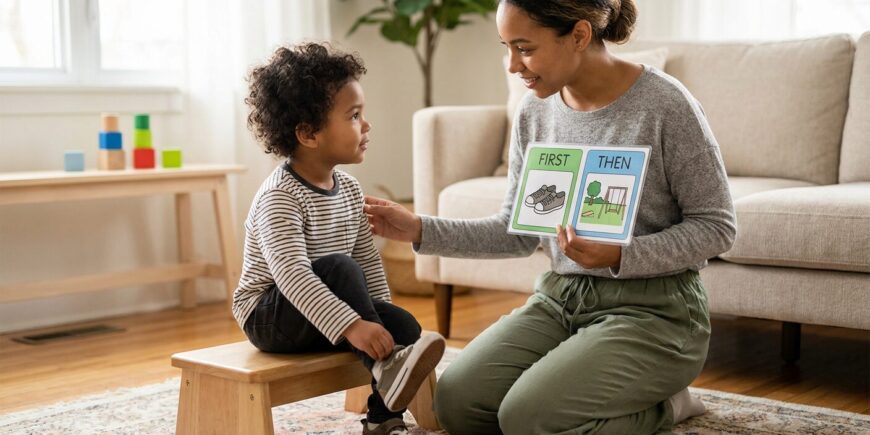
A first-then board for autism can make some of the hardest parts of the day feel more manageable. If your child struggles when it is time to stop a preferred activity, get dressed, get in the car, start homework, or settle into bedtime, a simple two-step visual can make the next expectation easier to understand. Instead of repeating verbal reminders, you are showing what is happening now and what comes next.
That does not mean a first-then board will fix every routine challenge or make transitions easy overnight. What it can do is lower uncertainty, cut down on extra language in a stressful moment, and give your child a clearer path through one hard transition at a time.
Why Daily Transitions Can Feel So Hard for Many Children With Autism
Many transition struggles are not about defiance. Often, the shift feels abrupt, the next step is not clear yet, or a preferred activity is ending before a child feels ready. In a busy home routine, that can turn into frustration very quickly.
For some children, the hardest part is stopping something they enjoy. For others, it is moving into a task that feels harder or less predictable, like getting dressed, sitting down for a meal, or starting homework. Changes in timing, too much talking from adults, sibling activity, or an unexpected schedule change can make the moment even tougher.
Age can shape how those moments look. Younger children often need immediate, concrete support right in the middle of the transition. School-age children may struggle more with competing demands, like leaving screens or moving from play to homework. Older kids may need more previewing, more ownership, and visuals that feel age-appropriate.
If you are also working on the bigger picture, it can help to pair this strategy with broader support for daily routines at home. A first-then board is one useful tool, but it is not meant to carry the whole routine by itself.
What a First-Then Board Is, How It Helps, and When It Makes Sense
A first-then board is a two-step visual support. The first box shows the current task or expectation. The then box shows what comes right after. That next step might be a preferred activity, a familiar routine, a short break, or simply the next part of the day.
This works because it makes the sequence visible. In a tense moment, a clear visual is often easier to process than a longer explanation. Instead of hearing a string of reminders, your child can see the immediate path in front of them.
A first-then board usually fits best when:
- one transition keeps breaking down
- your child responds well to simple, visible sequencing
- you want to target one routine before layering in more supports
It may not be enough when:
- the routine has several steps, not just two
- your child needs more preview than a simple board can give
- the transition involves safety concerns, severe distress, or frequent escalation
That is when a fuller visual schedule may be a better fit. A first-then board is best for short, immediate support. A visual schedule is more helpful when your child needs to see a longer sequence or understand more of the day ahead of time. If you want more background on visuals in general, this guide to visual supports in ABA therapy can add context without pulling this article away from transitions.
The FIRST Fit Framework
F: Find the friction point
Start with one transition that causes repeated stress. It might be leaving the tablet, getting dressed in the morning, moving to the bathroom before bed, or starting homework after school. Be specific about the exact moment that gets stuck.
That specificity matters. A goal like “better behavior” is too broad to guide you. A target like “shoes on before leaving the house” or “turn off the TV, then wash hands for dinner” is much easier to support. When you focus on one routine at a time, it is easier to notice what is actually helping.
I: Identify a meaningful then
The then step should feel clear, immediate, and worthwhile to your child. Sometimes that means access to a preferred activity. Other times, it means moving into a predictable next step that is already part of the routine.
For a younger child, “first pajamas, then story” may work better than a reward that happens much later. For an older child, “first homework for 10 minutes, then music break” may feel more respectful and realistic. The point is not to bribe. The point is to make the sequence easier to understand and easier to follow through on.
R: Right-size the visual
Choose a format your child can process easily. Some children do best with a real object, like holding a shoe before leaving the house. Others respond better to a photo, an icon, or a few written words.
Keep it as simple as the moment requires. A rushed morning is not the best time for a crowded chart with too much language. The visual should be familiar, easy to scan, and consistent across caregivers.
S: Support the routine consistently
How you present the board matters. Show it calmly. Use short language. Point, pause, and give your child a moment to process instead of filling the space with more talking.
Consistency across adults helps the tool feel predictable instead of random. If one caregiver shows the board before the transition and another only brings it out after a child is already upset, it becomes harder for the routine to stick. If you want more support around carryover at home, these resources on supporting ABA work at home and family training for autism support connect naturally to this step.
T: Transition up when needed
A first-then board is meant for a short sequence. If the same routine keeps falling apart even with consistent use, or if your child clearly needs more than two steps shown at once, it may be time to move up to a fuller visual schedule or a more layered support plan.
Other signs include needing more preview before changes, distress across several routines instead of one, or a transition that stays unsafe or highly disruptive. In those cases, the next step may involve environmental adjustments, schedule changes, or coordinated planning with your ABA team. If bigger routine changes are part of the challenge, this article on adjusting to new environments and transitions can also help.
How to Build and Use a First-Then Board at Home
Start by choosing one routine to target first. Pick a transition that happens often enough for practice and causes enough stress that improving it would make the day feel easier. For many families, that means mornings, screen-time transitions, or bedtime.
Next, write the first step in simple, concrete language. “Get dressed” is clearer than “be ready.” “Bathroom” is clearer than “start bedtime.” Then choose a then step your child actually understands. That could be breakfast, the car ride, outside time, a favorite song, a story, or another expected next activity.
Then choose the visual format. Younger children may need larger pictures, photos, or object cues. School-age children may do better with icons and short phrases. Older children may prefer written words, a small card in a planner, or a dry-erase routine board they help create.
Place the board where you can use it before the transition gets hard. That might be on the refrigerator, near the front door, beside the tablet charging station, or in the bathroom. Try to show it early rather than waiting until frustration is already high.
When you use it, keep your wording brief. You might say, “First shoes, then car,” while pointing to each step. If your child needs a reminder, come back to the board instead of turning the moment into a long negotiation. Give the routine time to build. This kind of support often works better after repeated, predictable use than after one or two attempts.
The board should support understanding, not add pressure. If it starts to feel like one more demand in an already hard moment, simplify it. The best version is the one your child can actually use.
Real-Life First-Then Board Examples for Daily Transitions
Morning routine transitions
Morning routines move fast, which is one reason they can fall apart so easily. A first-then board helps by narrowing the focus to the next doable step.
Examples include “first get dressed, then breakfast,” “first bathroom, then shoes,” or “first shoes, then car.” For younger children, use clear photos and keep the pair immediate. For older children, a written card or whiteboard version may feel more appropriate. If mornings are stressful in a broader way, it may help to pair this with a bigger plan for more predictable daily routines.
Leaving preferred activities
This is one of the most common ways families use a first-then board. When a child is deeply engaged in a preferred activity, verbal warnings alone may not feel concrete enough.
You might use “first turn off tablet, then snack,” “first clean up blocks, then outside,” or “first one more minute, then bath.” Previewing matters here. Show the board before the activity ends, not only at the point of conflict. If screen transitions are a major source of stress in your home, this guide on managing screen time for kids with autism can support the bigger picture.
Homework, mealtime, and bedtime transitions
These routines usually go better when the board matches what your child already expects from the evening. Examples include “first homework, then music break,” “first wash hands, then dinner,” or “first teeth, then story.”
School-age children usually respond better when the wording feels practical rather than babyish. Older kids may do better when they help choose the visual, decide where it lives, or agree on what comes next. That small bit of ownership can make the support feel more respectful and easier to use consistently.
Common Mistakes, Troubleshooting, and When to Move Beyond a First-Then Board
One common mistake is choosing a then step that is too delayed or not especially meaningful. If the next step does not feel real enough, the board may not reduce the stress of the moment. Another mistake is adding too much language or too many visuals. During a hard transition, simpler is usually better.
Inconsistency can also get in the way. If the wording changes every day, the pictures keep changing, or the board only appears once your child is already highly escalated, it becomes harder for the tool to build trust. Sometimes the problem is not the board itself. It may be that the transition is too broad, the timing is too late, or your child needs more preview than two boxes can give.
If the board is not helping, step back and check the setup. Are you targeting the right transition? Is the visual clear? Is the then step believable and immediate? Are adults presenting it in a similar way? Over one to two weeks of steady use, look for signs that resistance is slowly dropping, transitions are shorter, or prompting is getting lighter.
Move beyond a first-then board when two steps are no longer enough. If the routine needs a longer sequence, if distress stays high despite consistent use, or if safety is a concern, a more complete transition plan may be needed. That could include a longer visual schedule, changes to the environment, or support from your ABA team to better understand what is making the routine so difficult.
First-Then Board Setup and Troubleshooting Checklist
Use this checklist to keep the process practical and focused.
Choose the transition
- Identify one repeat friction point.
- Define the exact first step.
- Clarify what success looks like.
Build the board
- Choose the then step.
- Select the visual type.
- Decide where the board will be used and stored.
Use it in the moment
- Preview before escalation.
- Use short, consistent wording.
- Keep the sequence immediate and follow through.
Troubleshoot or level up
- Note what is improving.
- Flag when the visual is unclear or the then step is not meaningful.
- Decide whether the routine needs a fuller visual schedule or added clinician guidance.
FAQ
What is a first-then board for autism?
A first-then board is a two-step visual support that shows what is happening now and what comes next. It is often used to make transitions and short routines feel more predictable.
How do first-then boards help with transitions?
They reduce uncertainty, lower language load, and make the next step visible. That can be especially helpful during routines like leaving screens, getting dressed, or moving into bedtime.
How do you make a first-then board at home?
Start with one hard transition, choose a simple first step and a realistic then step, and use photos, icons, drawings, or words that match your child’s level. Keep it easy to access and use it before the transition becomes difficult.
What is the difference between a first-then board and a visual schedule?
A first-then board is for short, two-step support. A visual schedule is better for longer routines with multiple steps or when a child needs more preview of what is coming.
Can a first-then board work for older children too?
Yes. The format can change with age. Older children may prefer written cues, more collaborative setup, and visuals that fit their routine without feeling too young.
A well-used first-then board can make daily transitions feel less chaotic and more manageable, especially when the focus stays realistic: one routine, one clear sequence, and one predictable next step at a time.

 Previous Post
Leave Your Comment